Printed in the Iowa City Press-Citizen, Sept. 6, 2009.
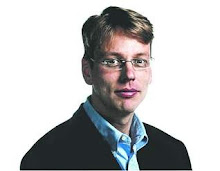
It's atypical for a student to come into the Iowa Writer's Workshop with a book already in print. But Benjamin Nugent seems neither a typical writer nor student. Author of "American Nerd: The Story of My People," Nugent said he is in the process of making a change from writing journalism to fiction and memoir.
Nugent demonstrated off that transition Wednesday when, during "Live from Prairie Lights," he read to a packed house from a short story included in the paperback version of "American Nerd." When he turned to the Q&A portion of the reading, however, Nugent focused exclusively on explaining the cultural history of nerds.
Here's some excerpts from an interview I did with Nugent earlier in the week.
Q: So what evolutionary advantage, if any, does "nerdiness" bestow?
A: Nerds have become an economically empowered class or subculture. They benefit because they think in ways that are compatible with technology and are good at thinking like computers. That's a sought-after skill in our economy. Now that the manufacturing economy has decayed, the job market requires people who are mentally capable of thinking like machines -- not just capable of working on a machine with their hands.
Q: So when did that advantage develop?
A: In the early industrial age people started worrying about what happens if people start to think too much like machines. A machine isn't like a tool, which a person controls. The machine at times starts to control the person -- or at least requires some kind of rhythm -- so that it almost seems to start thinking. People start to freak out, and that's when we start to get the concept of the nerd.
Before machines, you can't have a nerd.
Q: How do we go from people freaking about how much machines are controlling their lives to the concept of the nerd?
A: Until the Romantic Era we tended to think of human beings in contrast to animals. We are rational; animals are not. That's what makes us human. Then machines enter the pictures, and we start to get confused. Suddenly, we're not the only things in the world that can think.
So suddenly people who are good at reasoning become identified as being less human. We get Dr. Frankenstein -- who I view as an early nerd -- up in his lab, caring more about his technology than people. He's become a little less human because of how good he is with machines.
Q: As we continue to move into the Information Age, aren't we becoming a more nerd-dominant culture?
A: It's important not to elide cultural empowerment and cultural prominence. Nerds are still not culturally empowered. Economically empowered, sure. But that doesn't make it any easier to be a nerd in junior high. The fact that hipsters in their 20s like to dress like you doesn't make you any more socially empowered within your junior high.
When I talk with junior high kids, they say, "It's great that there are more nerd protagonists on sit-coms, but that doesn't mean people are nice to me."
Q: How is the concept of the "nerd" changing with more people being diagnosed on the autism spectrum?
A: There is a lot of overlap between what we call "nerdy" in our pop-culture and the people who have Asperberger's syndrome. But it's important to say that they are not the same thing. You can be a nerdy kid and grow up into a kid that isn't a nerd. Asperberger's is a neurological condition.
Q: You've subtitled your book, "The Story of My People." Are you a typical nerd?
A: One of the reasons I didn't talk about myself -- I instead interviewed my friends from junior high who were nerds -- is that I'm not that typical. I was a nerdy kid, but I became a frantic social climber as a teenager. So, I'm not a clear-cut case.
Q: What are you hoping readers will take from this book?
A: I hope the fact that you can read a history of the category of "nerd" will help people come to realize the superficiality of the concept. I hope it helps people wake up and see what an inconsistently -- though fascinatingly-- applied historical phenomenon this concept has been.
Opinion editor Jeff Charis-Carlson can be contacted at jcharisc@press-citizen.com or 319-887-5435.